
Uhuru Peak Kilimanjaro
Kilimanjaro Uhuru Peak: Your Definitive Guide to Reaching the Roof of Africa
Soaring to a majestic 5,895 meters (19,341 feet) above sea level, Kilimanjaro Uhuru Peak stands as the undisputed pinnacle of the African continent. Perched atop the snow-dusted crater of Mount Kilimanjaro in northern Tanzania, Uhuru Peak represents the ultimate triumph for thousands of adventurers each year. It is a place where grit, determination, and natural beauty converge.
Distinguished from many of the world’s formidable massifs, Uhuru Peak is a “trekking peak.” This means it requires no technical mountaineering gear like ropes or ice axes making it remarkably accessible. However, “accessible” does not mean “easy.” Success on this mountain demands peak physical conditioning, mental fortitude, and a strategic approach to acclimatization under the guidance of expert professionals.
Whether you are pursuing the legendary Seven Summits, seeking the raw beauty of Tanzania’s highlands, or fulfilling a personal quest to stand on Africa’s roof, this comprehensive guide provides the essential insights needed for a successful 2026 expedition.
Throughout this guide, we explore the mountain’s unique geography, optimal climbing routes, altitude management strategies, and the life altering experience that awaits you at the summit.
What Is Kilimanjaro Uhuru Peak?
Uhuru Peak is the crowning point of Mount Kilimanjaro and the highest elevation in all of Africa. It is located on the rim of Kibo, the tallest and youngest of Kilimanjaro’s three volcanic cones.
The name “Uhuru” translates to “Freedom” in Swahili. The summit was renamed in 1961 to celebrate Tanzania’s independence, lending the peak a profound historical and cultural resonance.
Reaching the summit is a multifaceted achievement. For climbers, it is the culmination of a journey through five distinct ecological zones. It symbolizes the ability to endure and adapt, transitioning from tropical heat to arctic cold in a matter of days.
Where Is Uhuru Peak Located?
Uhuru Peak is situated within the protected boundaries of Kilimanjaro National Park in North Tanzania, near the border with Kenya. This massive “sky island” rises abruptly from the scrublands below, often visible from miles away across the East African plains.
The Kilimanjaro massif is comprised of three distinct volcanic vents:
Kibo: The central, snow-capped dome and home to Uhuru Peak.
Mawenzi: A jagged, technical peak reaching 5,149 meters.
Shira: An ancient, eroded cone that has collapsed into a scenic plateau.
Uhuru Peak sits on the southern edge of the Kibo crater, offering views of shrinking glaciers and the vast, shimmering horizon of the Maasai Steppe.
Why Is Uhuru Peak Famous?
Several factors contribute to Uhuru Peak’s status as one of the most iconic destinations on Earth:
1. The Highest Point in Africa
As one of the “Grand Slam” points of geography, standing on Uhuru Peak means you are at the highest possible natural point on the entire continent.
2. A Member of the Seven Summits
For elite mountaineers and ambitious hobbyists alike, Kilimanjaro is a mandatory checkbox for the Seven Summits challenge—the quest to climb the highest peak on every continent.
3. Accessibility for Hikers
Unlike the technical ice walls of the Himalayas or the Andes, Kilimanjaro is a “walk-up” mountain. This allows fit individuals without specialized climbing backgrounds to experience extreme altitudes.
4. Journey Through Five Ecosystems
Climbing to Uhuru Peak is like walking from the Equator to the North Pole in five days. Trekkers traverse:
Cultivated Farmlands
Lush Rainforest
Heath and Moorland
High-Alpine Desert
The Arctic Summit Zone
5. The Legendary Sunrise
Most summit pushes begin at midnight so that climbers reach the peak at dawn. The sight of the sun rising over the Indian Ocean, illuminating the ancient glaciers and the vast Tanzanian plains, is widely considered one of the most beautiful sights in the natural world.
The History Behind the Name
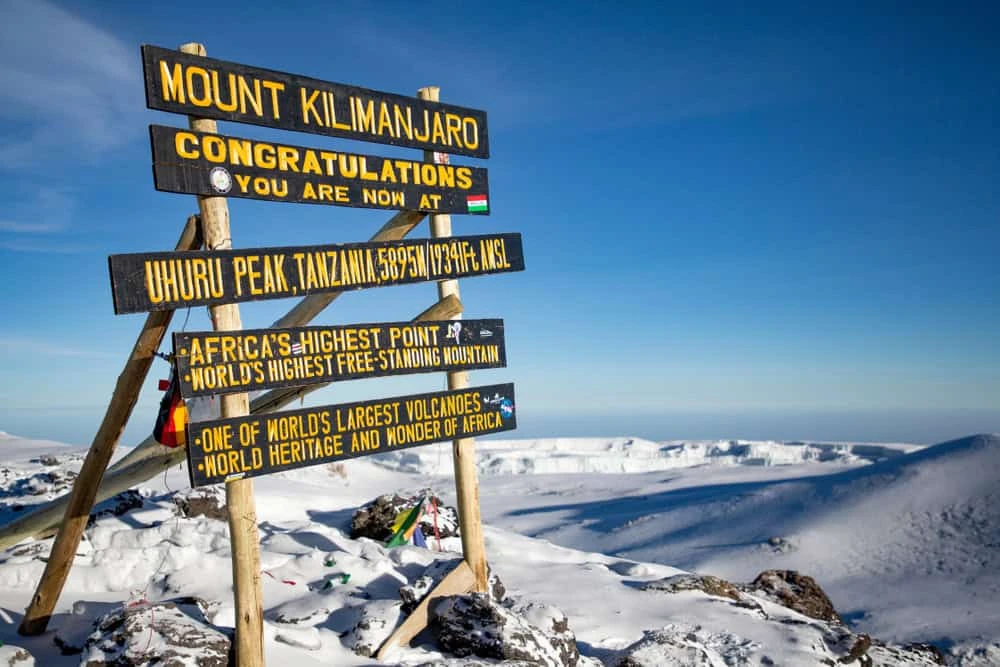
During the German colonial era, the peak was known as Kaiser Wilhelm Spitze. Following Tanganyika’s independence in 1961, the name was changed to Uhuru Peak to signify the birth of a new, sovereign nation. Today, the wooden sign at the summit is one of the most photographed landmarks in Africa, representing both national pride and the personal victory of those who stand before it.
Why Thousands Attempt the Summit Every Year
The draw of Kilimanjaro Uhuru Peak is magnetic. For many, it is a transformative “bucket-list” experience—a way to mark a milestone birthday, raise money for charity, or simply test the limits of their endurance.
The expedition is more than just a hike; it is an immersion into Tanzanian culture. The success of almost every climber rests on the shoulders of the local Chagga and Pare guides and porters, whose expertise and rhythmic “Pole Pole” (slowly, slowly) chants guide trekkers toward the heavens.
Stand on the Roof of Africa
Imagine the first rays of sunrise illuminating the glaciers as you take your final steps onto Uhuru Peak, the highest point in Africa. It’s more than a climb—it’s a life-changing achievement and a story you’ll cherish forever.
Let our experienced local team make your Kilimanjaro dream effortless. Explore our Kilimanjaro trekking packages or speak with our experts to design the perfect climb, with the right route, pace, and support for an unforgettable journey to the Roof of Africa.